


Sep 30, 2024
Ostavite poruku

Carbon fiber fabrics are widely used in aerospace, automotive industry, sporting goods and other fields due to their excellent mechanical properties and lightweight properties. However, its performance in high-temperature environments directly affects its application range and reliability. In recent years, research on the high temperature resistance of carbon fiber fabrics has made significant progress.
- Carbon fiber itself has good heat resistance and can maintain high strength and modulus at high temperatures. Research shows that carbon fiber remains structurally stable at temperatures up to 2000 degree .
- The high temperature resistance of carbon fiber fabrics not only depends on the characteristics of the fiber itself, but is also closely related to its weaving method and the choice of resin matrix.
1. Knitting method
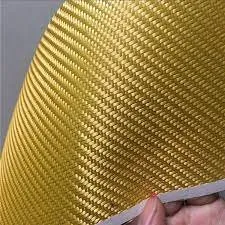
- Different weaving methods have a certain impact on the high temperature resistance of carbon fiber fabrics. For example, plain weave fabrics have better dimensional stability at high temperatures, while twill weaves may exhibit better heat resistance under certain conditions.
2. Resin matrix
- The choice of resin matrix is crucial to the high temperature resistance of carbon fiber fabrics. In high-temperature environments, the thermal stability of the resin matrix directly affects the performance of the entire composite material. High-performance resins such as epoxy resin and polyimide exhibit good thermal stability at high temperatures.
- In recent years, researchers have improved the high-temperature resistance of carbon fiber fabrics through surface treatment and adding nanoparticles. For example, by coating the surface of carbon fiber with a silane coupling agent, its interfacial bonding strength at high temperatures can be significantly improved.
- Adding nanoparticles (such as carbon nanotubes, graphene) can also enhance the high temperature resistance of carbon fiber fabrics. These nanomaterials can form a network structure and improve the thermal stability of the overall material.
- The research and development of new carbon fiber fabrics is also one of the focuses of current research. For example, researchers have developed carbon fiber fabrics with self-healing capabilities that maintain good mechanical properties at high temperatures and can self-repair damage.
- In addition, by optimizing the weaving process and structural design, the dimensional stability and durability of the new carbon fiber fabric at high temperatures have also been significantly improved.
- In the aerospace field, carbon fiber fabrics are widely used in components in high-temperature environments, such as engine nacelles, jet nozzles, etc. By optimizing the resin matrix and weaving method, the carbon fiber fabric exhibits excellent heat resistance at high temperatures, ensuring the reliability and safety of the components.
- In the automotive industry, carbon fiber fabrics are used to manufacture high-temperature components such as exhaust systems, turbocharger housings, etc. These components work at high temperatures, and the high-temperature resistance of carbon fiber fabrics ensures their long-term stable operation.
Research on the high-temperature resistance of carbon fiber fabrics has made significant progress, and its stability and reliability in high-temperature environments have been improved through surface treatment and the addition of nanoparticles. In the future, with the development of new materials and new technologies, carbon fiber fabrics will show greater potential in more high-temperature applications.
Pošaljite upit